Parisian Extravagances, Victorian Fears
This will decidedly be a post from art's outer fringes, but Gueldry's painting genuinely took me aback. Haematophagy is a phenomenon well known among animals, and one said to have occurred among humans in earlier ages and among so-called primitive peoples. The haematophage best known to us is the mosquito, so the thing itself is hardly unfamiliar.
It is also well known that the modern-day Maasai — who can scarcely be called "primitive" — have a custom of drinking cattle blood mixed with milk, drawing it off so deftly that the cow is essentially none the worse for it. The Mongols, reportedly, would resort to drinking the blood of their mounts when faced with death by hunger or thirst. In the Mochica culture of Peru, too, blood was consumed during religious rituals; the same is said of the Scythians.
And of vampires, of course. We tend to associate the practice with legends, or with tales from distant lands and distant times. I thought so too — until suddenly…
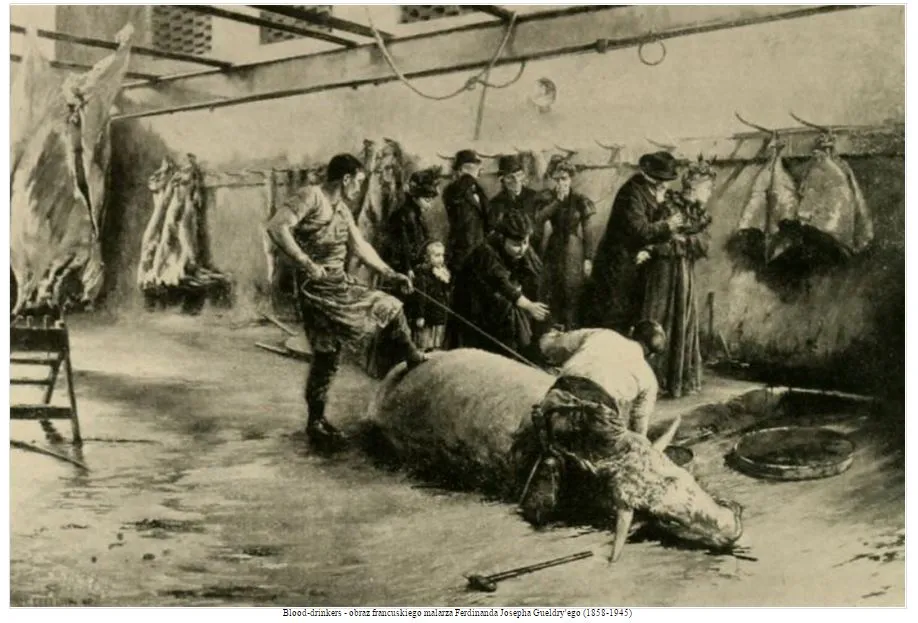 Haematophagy. Drinking ox blood at the La Villette slaughterhouse.
See for yourselves. Elegant ladies, some with children in tow, and dignified gentlemen, lined up in a grim slaughterhouse, waiting patiently for one of the butchers to draw blood into a cup, and then drinking the life-giving fluid like children drinking milk. Though it does seem that some of the ladies are turning a little queasy… Is this a true story? Did such a community really exist, or is it merely the painter's invention?
It existed, as it happens. The caption beneath the painting reads: "Boire le sang du bœuf à l'abattoir de la Villette" — "Drinking ox blood at the La Villette slaughterhouse." So the setting is no accident. It is the public abattoir of Paris, operating since 1867 as a modern slaughtering facility. And it really was the case: in the second half of the nineteenth century, Parisians came here not only for meat but also for fresh blood — prescribed by physicians as a restorative.
The treatment was meant to "fortify" — the ox, of course, excepted. Fresh, still-warm cattle blood was recommended for anaemia, melancholy, exhaustion, and various complaints we would today file under "somatic neurosis." Some physicians maintained it acted as a kind of natural transfusion. Patients arrived with their own vessels, sometimes with their children. Queues formed early in the morning, while the blood was still "at full strength" — that is liquid.
Meanwhile, across the Channel, another blood-related obsession was being born: the fear of vampires.
In 1897 Bram Stoker published Dracula, and Victorian London teemed with anxieties around blood, contagion, sexuality, and degeneration. Blood ceased to be a symbol of life — it was becoming a vehicle of horror, of sin, of the threat of social disintegration.
It is hard to say which is more unsettling: a gothic novel about a vampire, or a scene from everyday life in which a woman in a hat sips still-warm blood from an enamelled cup while holding a child by the hand.
Perhaps that is precisely why the painting makes such an impression — not because it is lurid, but because it is calm. So ordinary that it becomes disquieting.
Last 3 posts